
A few days ago Trump announced his plan to increase the Pentagon budget to $1.5 Trillion. An absurd sum that would result in a 50% rise. Naturally, people reacted in dismay. The US already has a major fiscal problem with rising Debt to GDP ratios and high deficits. Furthermore, the US military budget is famously larger than the next nine countries combined. Does it really make sense then to increase military spending?
The answer is yes. The US defense budget is not as large as people believe. It is not the primary cause of the country’s fiscal issues and it is likely insufficient to counter the rising threat of China and an increasingly belligerent Russia.
Purchasing Power
The big fallacy people commit when calculating military expenditures is forgetting to adjust for purchasing power. People understand quite well that goods cost different amounts in different countries. Services even moreso. The military budget is a combination of both, so we should naturally try to adjust for purchasing power. This gives us a very different picture:
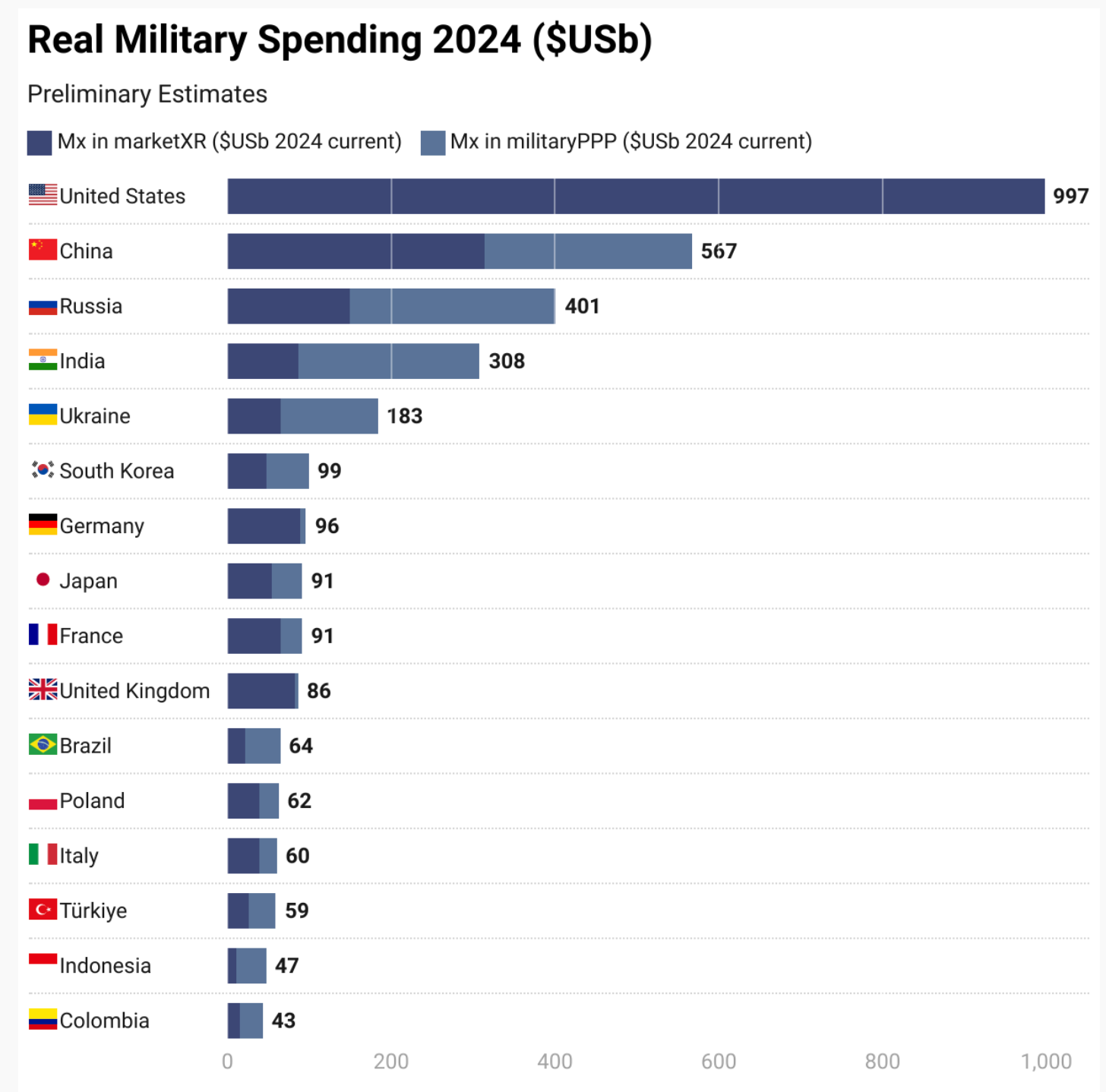
The United States remains in first place, but clearly cannot eclipse the combined spending of the next ten. It’s just above the spending of Russia and China.
But even these numbers do not tell the full story. Because of the large discrepancies in military personnel pay mean that the size of each country’s army is quite different from the military budget.
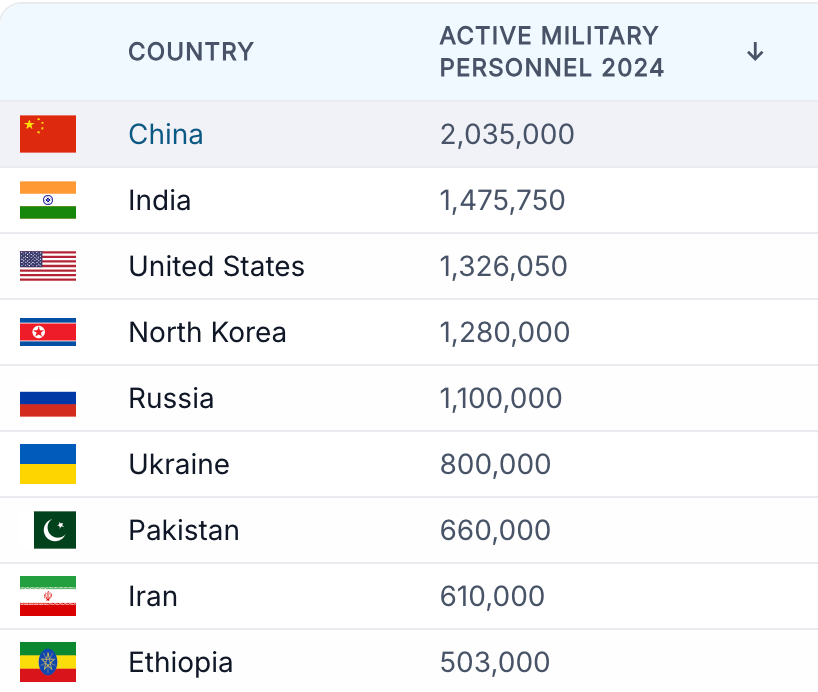
Now the US is far eclipsed by its adversaries. Of course, America’s technological superiority, intelligence, and cyber capabilities make up for this. But you should be starting to see that the mainstream narrative of “more than the next nine countries combined” is suspect.
But fine, these are just numbers pulled out of a hat. Why should you actually care about US military spending? One answer is that the US now faces a few key adversaries around the world. Russia, who is still invading Ukraine and continues to threaten NATO if the United States blinks; China, which has its gunsights on Taiwan and is preparing for its moment in the sun; Iran, which has recently become much weaker, but is a permanent concern for US Middle-Eastern policy. Given the global nature of US foreign interests, Pentagon policy during the Cold War advocated for a “Two-Theatre War” capability. Meaning that the United States should be powerful enough to engage in two major conflicts in different areas of the world. Ukraine and Taiwan being case in point.
Today that policy is very much violated. The US has been depleting its weapons stockpiles while supplying Ukraine, even as the conflict has cost the country a grand total of 0.1% of GDP per year. It’s difficult to believe that a country depleting its interceptor missile stockpiles through supplying Ukraine would be able to engage in a Two-Theatre War. Perhaps not even a 1.5 Theatre War. This problem is amplified when one looks at shipbuilding, an obviously vital part of a maritime nation’s power.
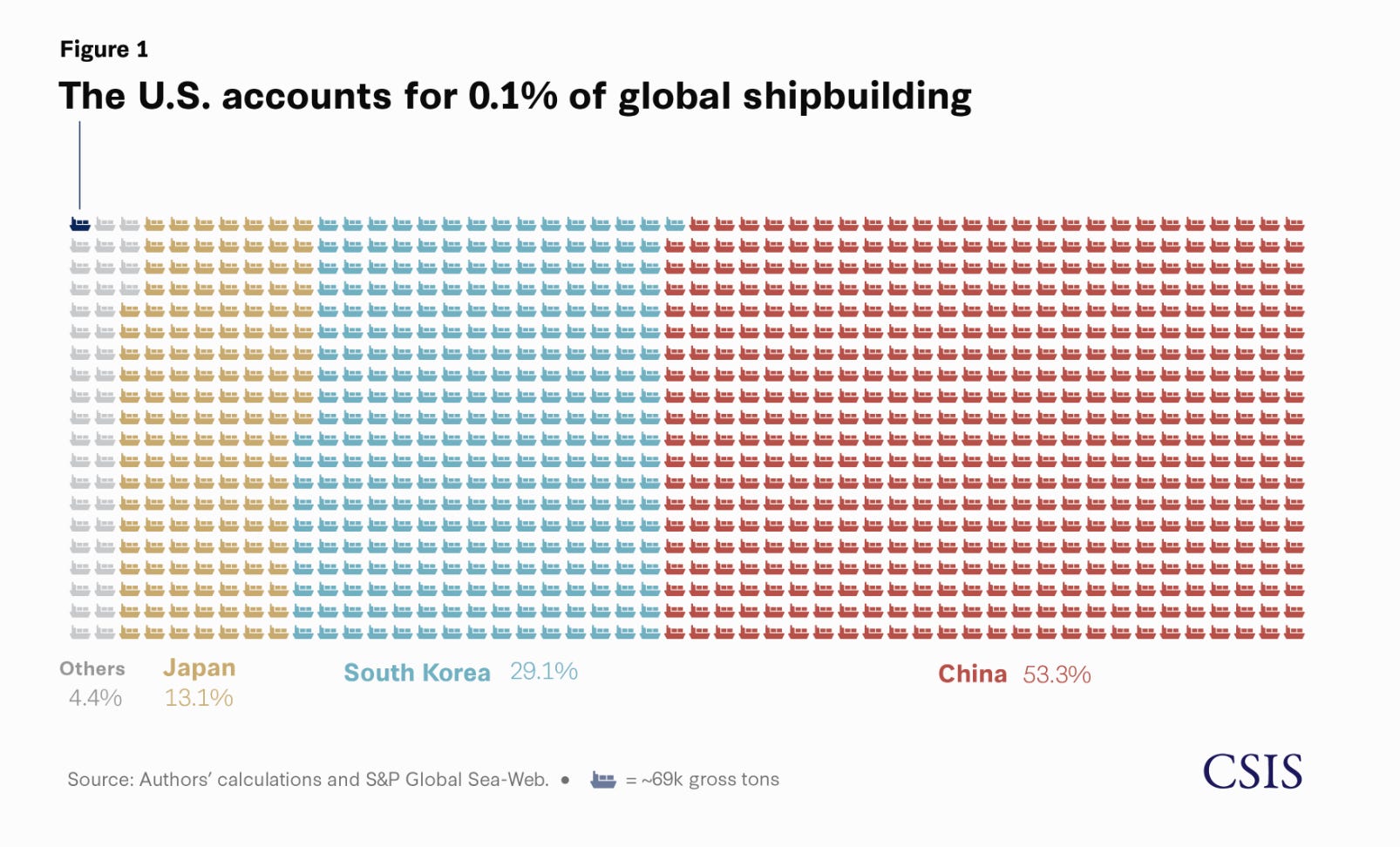
Do you see that? China accounts for half the world’s shipbuilding, while the US accounts for 0.1%. This is not the behavior of a country that is ready to deter great power war.
The Cost
OK fine, but what about the costs? It may very well be that the United States would benefit from increasing military spending to counter its adversaries, but what if it simply cannot afford to do so? Let’s unpack this. I’ll start with a simple graph displaying US defense spending as a proportion of GDP.
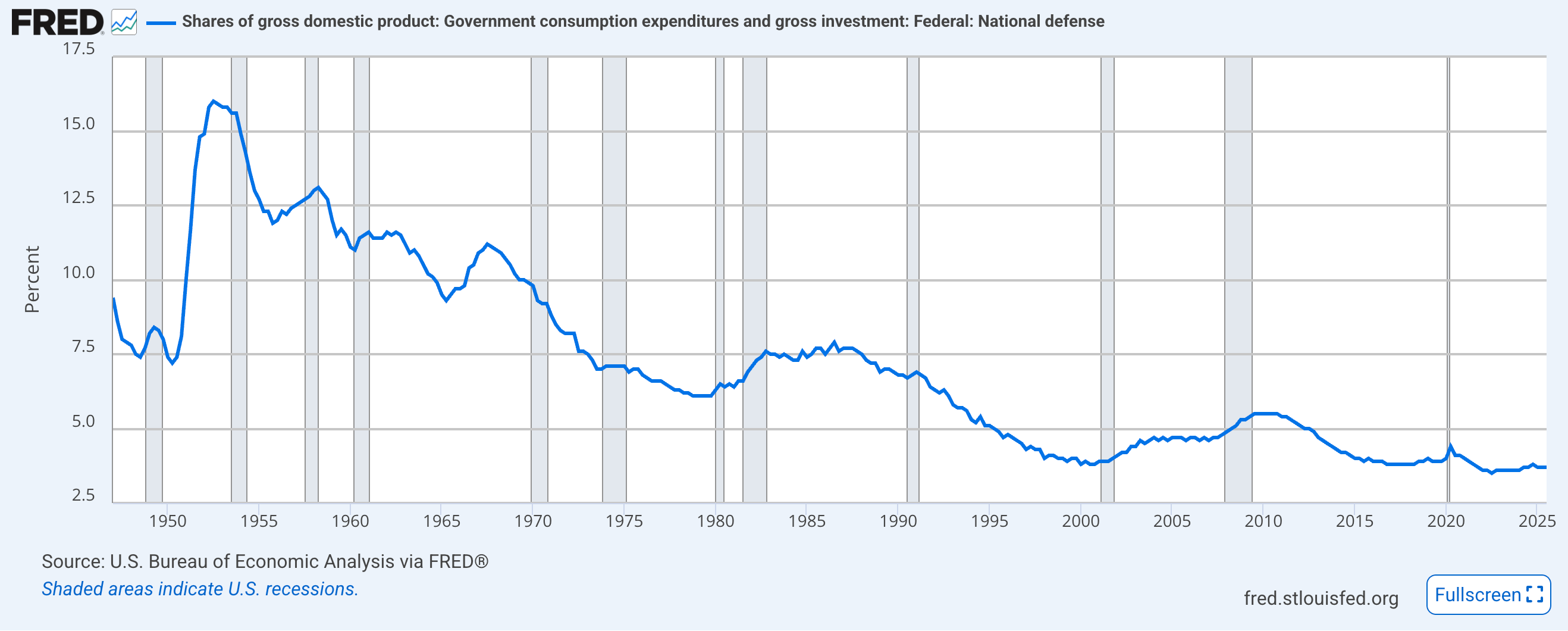
As you may notice, US military spending as a proportion of national income peaked during the height of the Cold War at 16%. Since then, it has been steadily falling and now constitutes a meager 3.7% of GDP. Much lower than the 5% of GDP threshold that Trump is pushing NATO countries to adopt. In fact, it’s right at the level where an increase to $1.5 Trillion would push the country above that threshold. Coincidence?
But fine, fine. Even if defense spending is a small proportion of GDP, is it not still a huge part of the Federal Budget? Something like half? Yes, but also no. Defense spending is indeed close to half of the discretionary budget, but it is just 12% of the full federal budget.
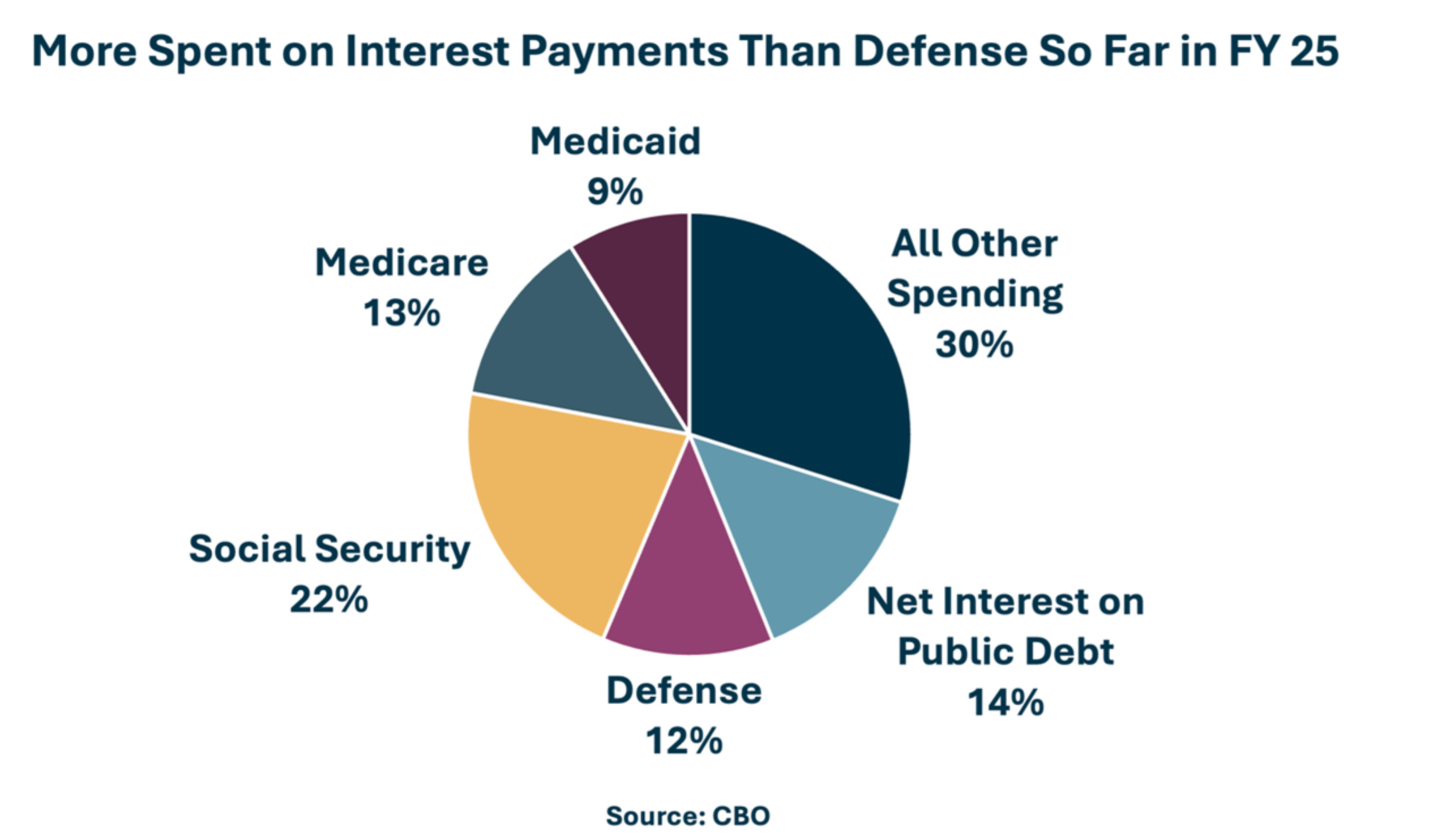
And as you can see from above, the real culprit of US overspending is social security, medicare, and medicaid. In fact, defense spending comes after net interest on the debt. Meaning that even a complete elimination of the US military would not be enough to balance the budget. If you’re looking for something to explain why the US is on the road to fiscal hell, defense is the wrong answer.
Conclusion
Look, I know you hate the fact that the US spends so much on defense. You probably blame that for the country not having universal healthcare. But these issues are completely unrelated. Defense spending when measured as a proportion of GDP is currently very low by historical (and even global) standards. And though you may blame the “Military Industrial Complex” for the War in Iraq, be glad that the Iraq War only led to the death of 4418 Americans, a number that is around 2% of Russian deaths in Ukraine. The future is not all ponies and hugs. And if the US does not step up defense spending, then its casualties will eclipse those of Russia, China will take Taiwan, and you’ll learn how annoying it is no live in an unipolar world where somebody else is the unipole.